Most of the winners this cycle didn't get there by trading — they got there by farming airdrops.
I don't want to start a total open season on farming by revealing too much information, but let me outline a few general principles — and how a motivated individual might apply them.
Why Do Airdrops Exist?
Before learning how to farm airdrops, we should first understand their raison d'être.
Early versions of products are always a little rough around the edges — thin liquidity, bugs, friction. Attracting early adopters is hard. So it's only fair that those who help make a product successful share in its success, becoming overnight millionaires when airdrops do hit.
And the best way for the average Joe to make a product successful? Using it. Stating to the world "I want the ideal version of this product to exist so much that I will use it in its primitive state." This, in turn, manifests that reality. Builders, investors, and regulators move mountains to meet the demand.
Capital Markets Don't Reward Patience
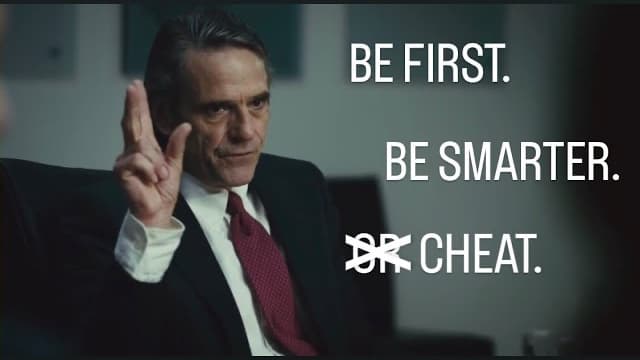
Still from Margin Call (2011) — the first rule: be first, be smarter, or... well, don't cheat.
As the quote goes from Margin Call, "There are three ways to win: Be first, be smart, or cheat". To most of us, the most accessible approach is to be first. Those who refused to use Hyperliquid in its infancy missed out on one of the most lucrative airdrops ever. I suggest that you do not make the same mistake.
Points contain an inherent forcing function—you don't get to sell your bags at 2x, 5x or even 10x. The psychologically hardest part of making 1000x is holding 100x—but by virtue of their illiquidity, points holders can ride huge surges without the temptation to exit early.
Pay Maker Fees, not Taker Fees
One way that an airdrop can work is by rewarding dollar volume. In this case, your goal is to maximize volume while minimizing cost — meaning you should try to pay maker fees, not taker fees, since maker fees are 1.5 bps, whereas taker fees are 4.5 bps, reducing your effective cost-per-point by 3x.
ALO orders (also known as post-only) avoid paying taker fees but face worse probability of execution. Liquid is working on a solution for a limited number of users to benefit from maker fees with guaranteed execution.
Delta-Neutral Hedging
Some airdrop formulas also reward open interest — the larger your positions and the longer you hold them, the more points you earn. However, done naively, optimizing for open interest exposes you to huge amounts of market risk. If you go 20x long XYZ, for example, a 5% drawdown in XYZ means that you get liquidated. And market movements are rather hard to predict — see 10/10.
In general, you should try to avoid direct exposure to any given asset if you do not have a strong opinion on its direction. There are other exchanges, like Ostium, where you can trade NDX perps, which tracks the same index as XYZ. Thus, if you go long on Ostium and short on trade.xyz, you are totally hedged. XYZ goes up? You lose money on trade.xyz and earn money on Ostium. XYZ goes down? You make money on trade.xyz and lose money on Ostium. Either way, the amount of money doesn't change.
If you want to completely guarantee zero exposure, one way to further secure this is to place take profits for each side of the trade at the liquidation price of the other side of the trade — ensuring that as soon as one position is liquidated, the other one is closed.
Furthermore, since you can use 20x leverage, with just $1M you can be long $10M on Ostium and short $10M on XYZ. This structure is risk-controlled, capital-efficient, and ideal for long-duration farming.
Just remember that NDX doesn't trade on weekends, so plan your entries and exits accordingly.
Airdrop Value Estimation: Ostium / XYZ
But look, cost basis is only one side of the equation. Let's try to quantify the value of Ostium / XYZ points, and compare it to the value of fees.
Ostium recently raised at around a $250M valuation. Due to the popularity of equity perps right now, it will probably at least 2-5x in value by the time of the airdrop, and then probably airdrop around 10-20% of its supply, giving us a total airdrop value between $50M and $250M. Ostium's points program runs over 50 weeks, so let's assume that each week is $1M - $5M of airdrop value, and $500K - $2.5M of airdrop value to traders (Ostium also gives airdrops to depositors in OLP, their native vault). Ostium does about $1B in weekly volume, so if you do $10M of volume going long, you're 1% of the volume, and by extension you'll receive about a $5,000 - $25,000 airdrop. You'll pay about 2.5 bps to open the trade (Ostium charges 5 bps for open + close), so you'll spend $2,500 in fees. That's about a 2-10x return.
If we estimate that XYZ's airdrop is worth $50M - $250M, and we assume that the points program will also be 50 weeks, that would be a $1M - $5M weekly airdrop. Assuming XYZ does about $300M volume this week, and assuming you pay maker fees only, selling $10M will cost about $3,000. That would be 3% of this week's airdrop, which will be $15,000 - $75,000, another 5-25x return!
Risks to monitor: crowding can dilute your points, and you are synthetically exposed to the size and probability of each airdrop occurring.
Once you understand this article, you will also understand the beauty of Liquid, the app I've built to enable this style of trading from your phone. Our vision goes deeper, but I'll save that for future writing...